Pressed botanical specimens gathered from garden, field, woodland and lane through the changing seasons.
2019–20
January 2022 — December 2023
California
Notes from Ventura County: garden and meadow, mountain trails and river preserve,
changing weather, visiting birds and the small signs of each season.
2022
This morning two sparrow-looking birds, with black striped heads, peered about the courtyard garden where I put a feeder.
Saw some interesting reddish coloured birds yesterday while out in the paddock with Ez—we went looking for worms and managed to find a few hiding under logs. Kirra dug a big hole, chasing the gophers.
A huge assortment of birds visited the courtyard this afternoon! What a delightful commotion!
Lots of busy little beings—towhees, sparrows, titmouse and someone new and special that I am very excited about: a white-breasted nuthatch, feeding upside down. At first I thought it was a tiny woodpecker!
A towhee took a long, leisurely bath in the fountain, fluffing her wings and splashing about in what seemed a joyful state.
This morning in the meadow, at the pond, I saw the blue heron, several ducks, two white egrets and some sort of northern-looking bird. The heron took off, disturbed by something, and circled over us, shrieking loudly overhead.
Everything is GREEN.
Made it around the Wills–Rice Loop Trail. 4.6 miles, not too arduous and only a 449.5 ft elevation gain.
Not much in the way of wildlife, but lots of plants thriving at the moment and clamouring for space after the rains of December.
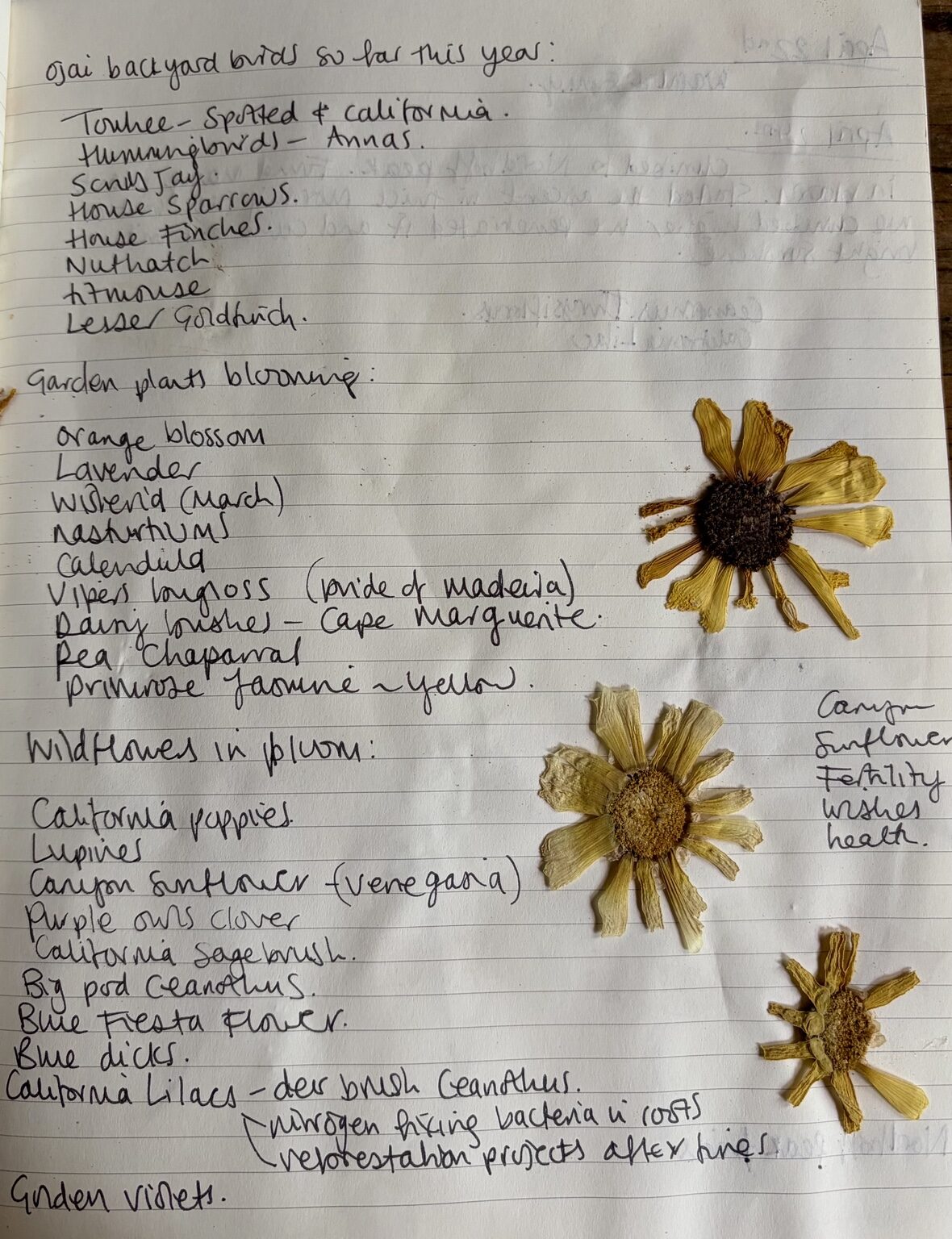
Hummingbird sage, some just starting to flower. Milk thistle—ouch—pricked my finger. Horehound thriving. Mugwort. California sagebrush. California figwort. California buckwheat.
I stopped on a little bench in the Nido Meadow to eat my breakfast burrito from Farmer & the Cook and looked down to see myself surrounded by my old friend plantain. It’s nice to see a familiar face out here.
California buckwheat Eriogonum fasciculatumMilk thistle Silybum marianumCliff aster Malacothrix saxatilis
A tsunami warning in effect for coastal areas after an undersea volcano erupted off of Tonga.
Brought in some surf of overhead (30–40) at around 3 p.m. Saw a gaggle of geese fly overhead when leaving Paint Aid. Looked like they were flying towards Lake Casitas, but they continued past it, towards the mountain beyond.
Windy evening and some rain.
Drove down to the beach at Rincon this afternoon. It was packed, so found a new beach a little further up at the Saltmarsh Preserve. Sadly no birds spotted there.
On the way home, as we winded back on the mountain road, a little skunk bumbled out ahead of us. Luckily, I was going slow and spotted him quickly. I tooted the horn and he threw up his little stink-tail and skirted out of there, no doubt leaving behind a putrid stench for the next vehicle to encounter.
Hiked up Cozy Dell to the lookout point. The trail is lined with all sorts of botanical treasures.
Cliff aster—sprouting but no flowers yet. Canyon sunflower, beautiful little yellow flowers on a large green bush. California peony about to bloom into stunning purple flowers. Golden yarrow—a type of woolly sunflower, at the moment just small feathery tufts of foliage but soon to have yellow umbilifer-like flowers. Mountain sweet cicely, a member of the Apiaceae family along with carrot, parsley etc. No flowers yet but looks like it’s getting tiny white ones.
Went for a short walk around the meadow. Happened upon a busy little California thrasher, rummaging about in the leaf litter.
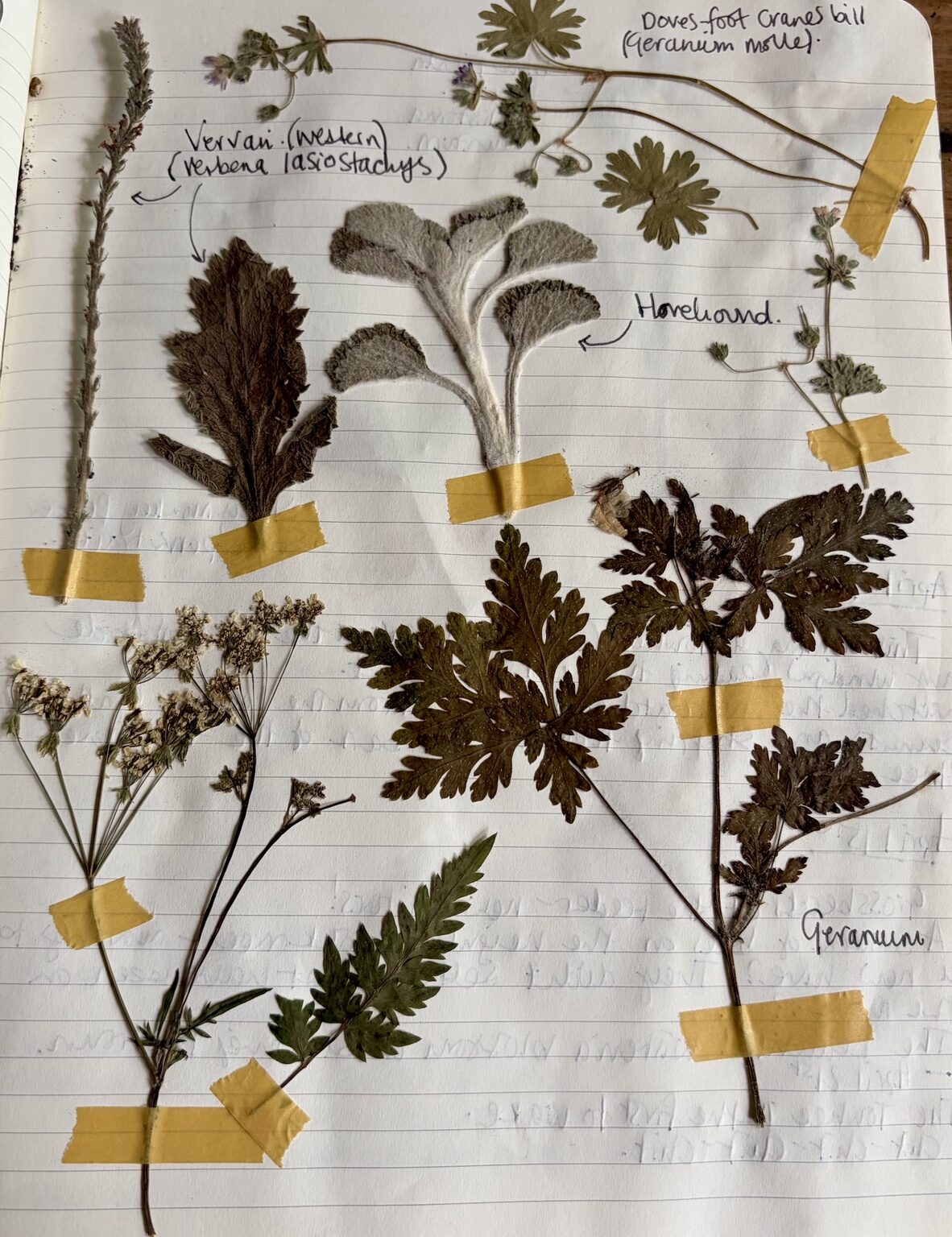
Found the beginnings of some vervain plants sprouting up, looking forward to the flowers.
Turkey vulture mating season. This morning the moon was setting in its usual place, above the garages, while a vulture sat, wings spread on a pylon in front of it, warming in the rising sun. Quite a beautiful scene.
The pair of red-tailed hawks—perhaps the same pair that hunt in the meadows?—have been circling overhead today.
A new bird at the feeder today, perhaps a type of finch. House finch with a reddish breast.
A frosty start but the sun beamed down from the start and now, at 3 p.m., it is warm and bright with a light breeze rustling the leaves of the oaks.
The courtyard feeder has been busy again today. Identified a new pair of visitors as house finches, red breasts and finch beaks. They’re quite flighty and not as easy to observe as the sparrows and towhees. I still fail to get a confident ID on the little black-headed sparrow types—black-eyed juncos?
Overcast start this morning. A still morning.
Had a run-in with petty spurge—nestled in amongst a delightful patch of edible chickweed. It is in the euphorbia family and oozes a white sap when broken—NOT edible and would cause digestive upset.
Overcast after yesterday’s sunny warmth.
An interesting sight as I waited to take my Covid test for work. Outside of the pharmacy in Ojai I saw a large group of egrets balancing precariously in a sycamore tree. I suppose it’s in close enough proximity to the meadow and school field where they feed. Also a small collection of tiny bushtits, gathered on a shrubby tree, eating something off it as I sat outside the gym.
We were blessed with one of nature’s great displays today as we walked down the bike path behind B&C. Two red-tailed hawks were engaged in aerial combat, as a tiny bunny squealed its last terror-filled protest. One bird was victorious and sat on the fence of a basketball court, triumphant, pulling the intestines out and ripping off the poor thing’s head.
A small group of five or six mule deer were grazing in a meadow off the 150 as we returned to Ojai from Carpinteria.
There are two subspecies of mule deer: the California mule deer and the Columbian black-tailed deer.
A different bird pecking about this morning—maybe a spotted male towhee?
At the end of the driveway were a pair of birds I didn’t recognise. The male was stunning—yellow and black with a bright eye.
A lot happens in a month in Ojai, in the spring. Events that would be spread out throughout the course of the summer season in England happen in an instant here.
Daddy longlegs—damsel flies?—swarming and blundering around the house. Bees of all sizes cover a tree in front of the house, the biggest bumblebees I’ve seen. Two Canadian geese flew overhead this morning.
We found a baby fox squirrel and I took him to a wildlife sanctuary down in Oak View.
Went to the river at Foster Park, lots of swallows in the air, diving, feeding. As we drove back through the underpass bridge they seemed to be nesting there.
Stepped outside in the evening to empty the compost. The air was still and the cloud cover was low. I spotted a hummingbird perched high on a tree limb. He darted down to the sage right beside me and began hungrily collecting nectar. It was one of those dazzling green ones with a bright red breast. So vibrant and iridescent. I watched him for a while. Then suddenly he changed course and buzzed right by my face into the sky.
Large swaths of poison hemlock growing along the freeway from Carpinteria–Santa Barbara. Also elderflower blooming.
The growing season comes in a flash of flowers, quickly followed by seed and berries.
The tell-tale signs of a titmouse, bobbing and flitting from branch to feeder. Little crest raised. Grey skies but mild.
We have moved to Ojai Drive in Oak View, had to say farewell to the old farmhouse with its paddock. The garden here is a truly magical haven with its high walls and wooden gates, casually ivy-clad.
A pair of perky little California thrashers hop about beneath the overgrown rosemary bushes and between the vines.
Last night a huge, blinding bright, full moon rose up above Sulphur Mountain. This home invites positive energy from all directions. An influx from the west, the warm, golden hum of morning, the release of days in a hue of pinks to the east. Desert sea breezes from the south, through the mountain valleys. The north quiet and still. A balance.
My English mugwort, grown from seed on Mead Drive, now thrives in a pot here.
Rumours of a bear in the neighbourhood. Someone’s chicken coop was destroyed.
The little lime—or orange?—tree here is covered in rich green fruit.
Planted yarrow, nasturtium, kale, calendula and clary sage in the front garden. Hopefully they take.
Summer solstice. Here the summer is still, quiet, in comparison to the hum of an English summer.
Been replanting and moving things around the garden. Trying to keep the potted plants happy.
There are a family of towhees—black and white spotted, not the usual brown—living in the front garden. I’ve seen the fledglings hopping about a few times. Also a titmouse pair, jays and house finches visit the feeder.
Happened upon the most spectacular moth: “Antheraea polyphemus.” A type of giant silk moth. Average wingspan 15 cm. Apparently fairly common in North America.
109°!
We are being invaded by ants—not sugar ants that cover your honey pot, but similarly sized. These poor pilgrims are searching for water. 111° yesterday.
Rumours of rain this afternoon. The air has finally cooled as the edges of Hurricane Kay tickled the rain gods into a pitter-patter. The soils soaked up what they could with greedy gulping.
Woke to the familiar sound of gnawing rodent teeth. A squirrel was sat on the bench, helping itself to a selection of acorns Ezra had collected.
Cooler weather, slightly overcast. Almost autumnal.
A chilly, misty morning. A dove coo’s in the pines—but it sounds like a cuckoo.
The nasturtiums in the planters have one pretty peach flower on them.
Strong winds in the night!
Two blessed days of precipitation!
House finches, sparrows, juncos, jay, titmouse, nuthatch and hummingbirds zooming to and fro. A hive of activity. Warming sunshine, lifting mists.
49°. Sunshine.
We’ve had some weather! Real English weather. It’s been glorious. Strong winds, pouring rain, drizzle, big white clouds blowing across stormy skies. The hillsides have turned green and there is a small river flowing at the bottom of our garden where once was a dried-up rock bed.
Yesterday was covered in frost and ice.
The rains came. Everything is stranded in a thick fog this morning. Yesterday I found two owl pellets full of tiny rodent bones.
2023
Yesterday’s downpours filled the rivers. Our creek was the fullest I’ve seen it, roaring through the little gully. This morning it still flows, as the beaming winter sunrise lifts the moisture to the sky—mists rising off fences and sodden tree limbs. Birds busy.
Some serious rainfall has set in, pouring solidly since 2 a.m. It continues to come down in torrents. The river is bulging, roaring and expanding by the hour. Hillsides are collapsing—lots of road closures. Thunder rumbles.
A little grey-and-white nuthatch flies over, crawls up and down the trunk of the old oak tree and stashes a seed in one of the deep crevices. Resourceful little beings.
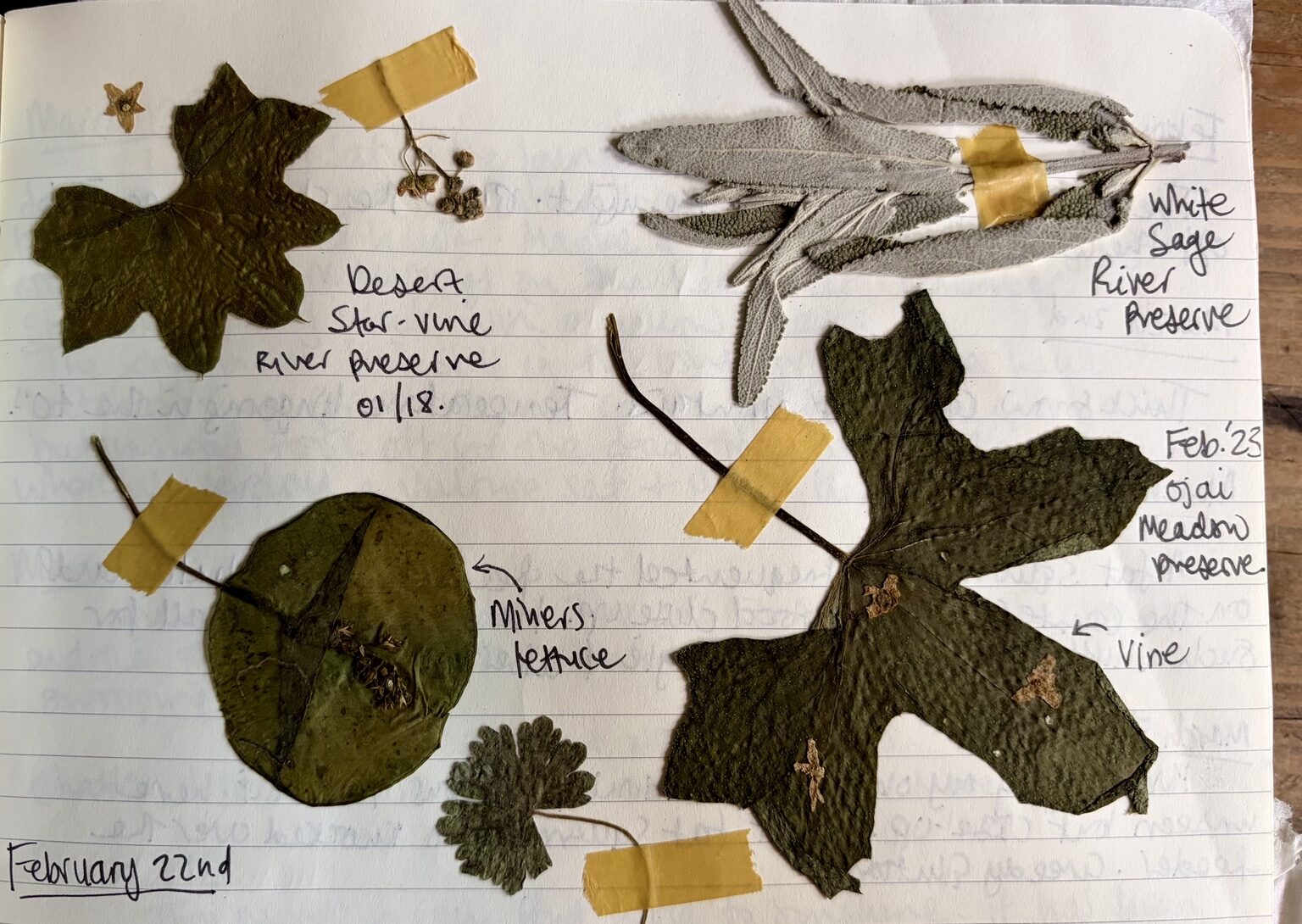
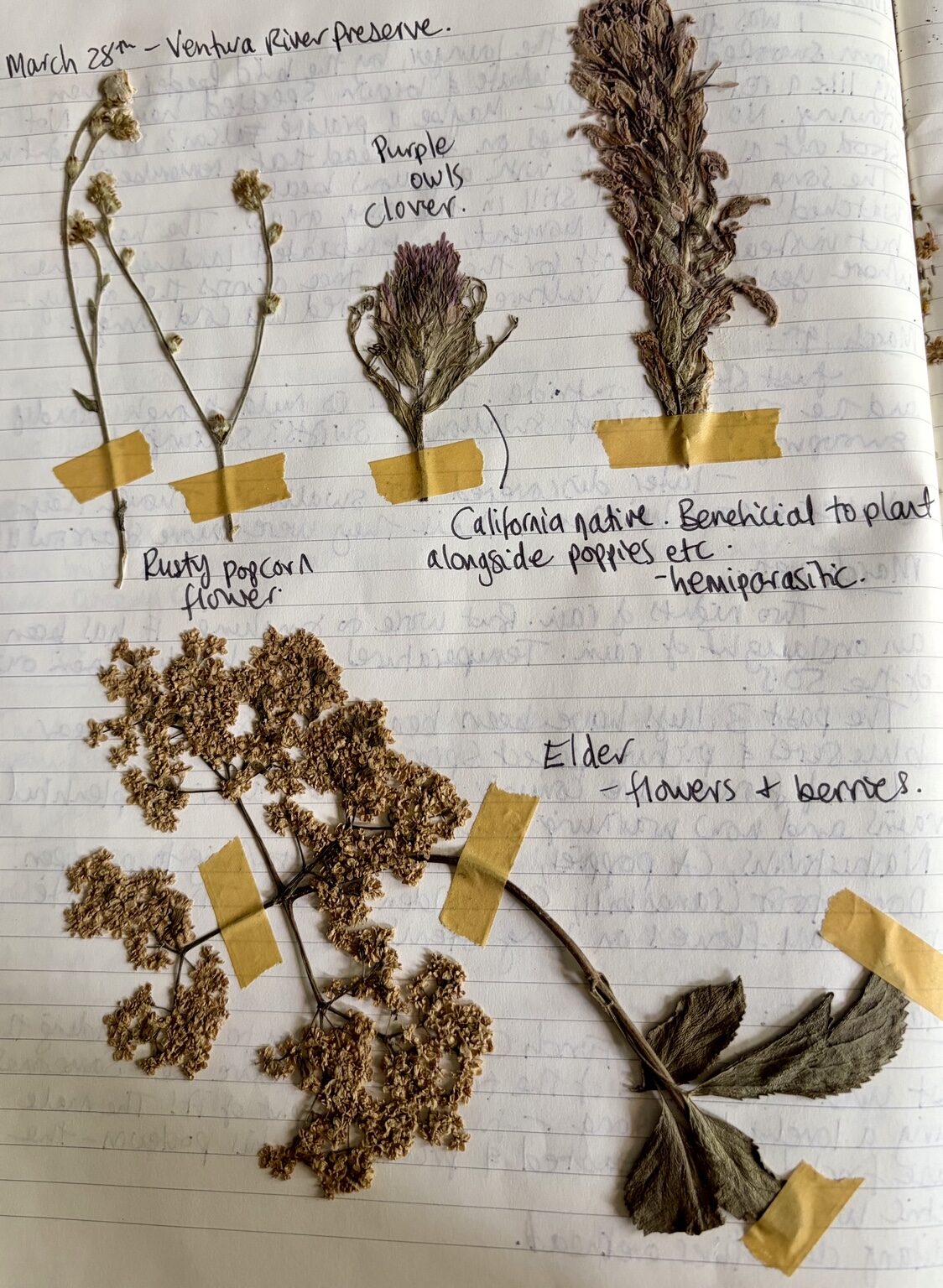
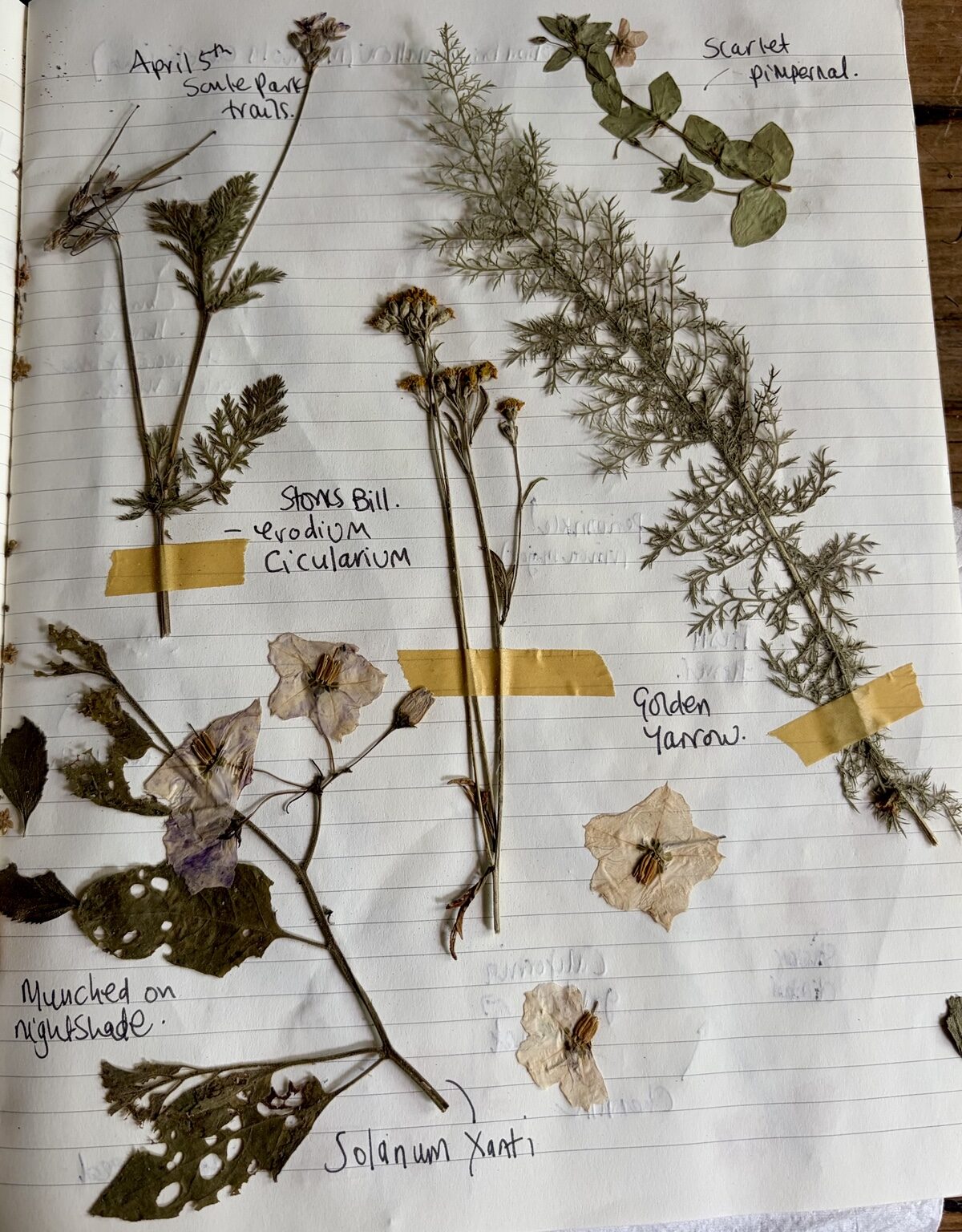
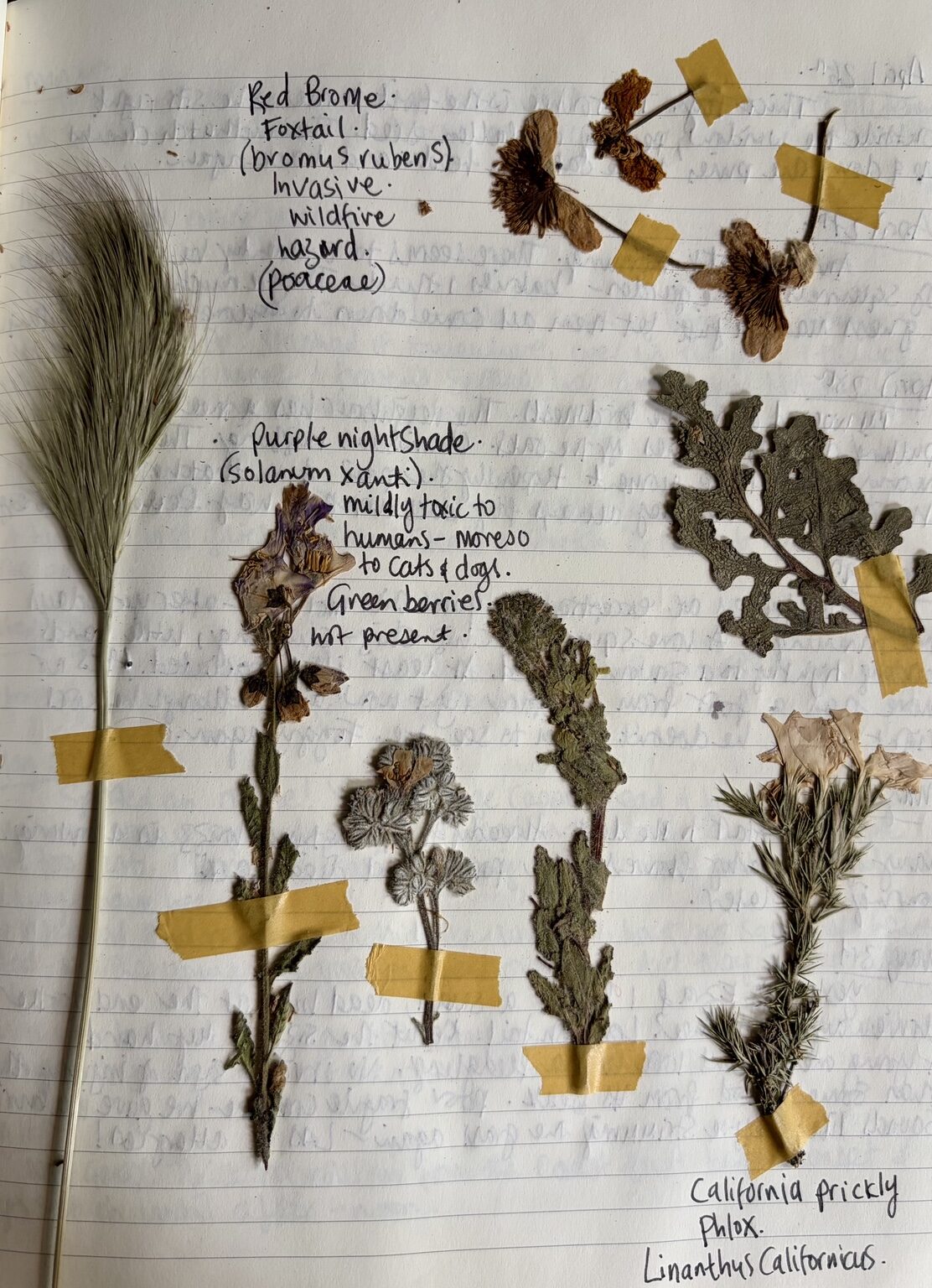
Pressed specimens gathered in Ventura County.
Glittery frost sits here and there; snow dusts the mountain peaks. Flocks of tiny birds raid the feeders.
Took a walk in the meadow. Things are springing to life—a rapid and vibrant race to grow and flower. Plenty of small herbs: miner’s lettuce, cleavers and mustard greens. Bigger plants like horehound and vervain begin their ascent towards the sky.
Saw a group of noisy grackles on the pond, along with two ducks, plus a rabbit, plenty of ground squirrels and a pair of red-tailed hawks soaring high above the wetlands.
A squabble of lesser goldfinches at the feeder this afternoon, mostly females. The wind is really blowing, but they seem unphased by the movement. Spots of rain threaten on and off.
Yesterday hiked the Shelf–Pratt Loop—spatterings of wildflowers: lupines, poppies, colours of purple and orange.
39°. More rain coming and not going to warm up. The birds finally found the new feeder that I’ve hung from the oak outside the bedroom window. They persevere through the wind and rain, little wings dripping as they navigate the treacherous conditions. I can barely make them out through the rain-soaked window pane. The occasional bright yellow breast of the lesser goldfinch stands out in the grey muck.
The weather got violent in the night. Blew the clock and a painting off the wall outside.
Thick snow covers the mountains. Temperature lingers in the forties.
A fat squirrel has frequented the feeder. A nuthatch lands on the counter; I get a good close-up. He has a lovely call for such a little fella—“cra cra”—single and assertive.
I’m enjoying my observation window—it seems I can sit here unseen but close-up. That fat squirrel has knocked over the feeder. Greedy glutton!
The day is very English. Almost spring, hope feeling; although here everything is already flowery and green.
The rain falls again! Poured all day and all night. Deluge. A fat grey squirrel clears up the scraps I left out for her. The feeders are occupied almost instantaneously—so many little songbirds. Nesting season.
Yesterday a scrub jay with a beakful of nest material swooped down and startled a towhee who was foraging by the front door. The nuthatches visit the feeder, small squeaking noises and wing flutters back and forth—imprinted onto one another.
I was just sat on the lounger by the bird feeder when down swooped a small, white-and-brown speckled hawk. Not big like a red-tailed hawk. Maybe a prairie falcon? Very light in colour, no dark markings on the head that I remember. Stared at us with a yellow beak.
The songbird hid still in the long grass. The hawk watched for a moment, contemplated landing, but instead took off for the dead tree across the gully—where yesterday a vulture sat and dried his cold wings.
Just stepped outside. The air is mild though cloudy, and the sky is full of swallows? Swifts? Soaring and swooping. Later discovered: not swallows. Though they chatter and soar like them, I think they were more sparrow-like.
Two nights of rain. But woke to sunshine. It has been an onslaught of rain. Temperatures have barely risen out of the fifties.
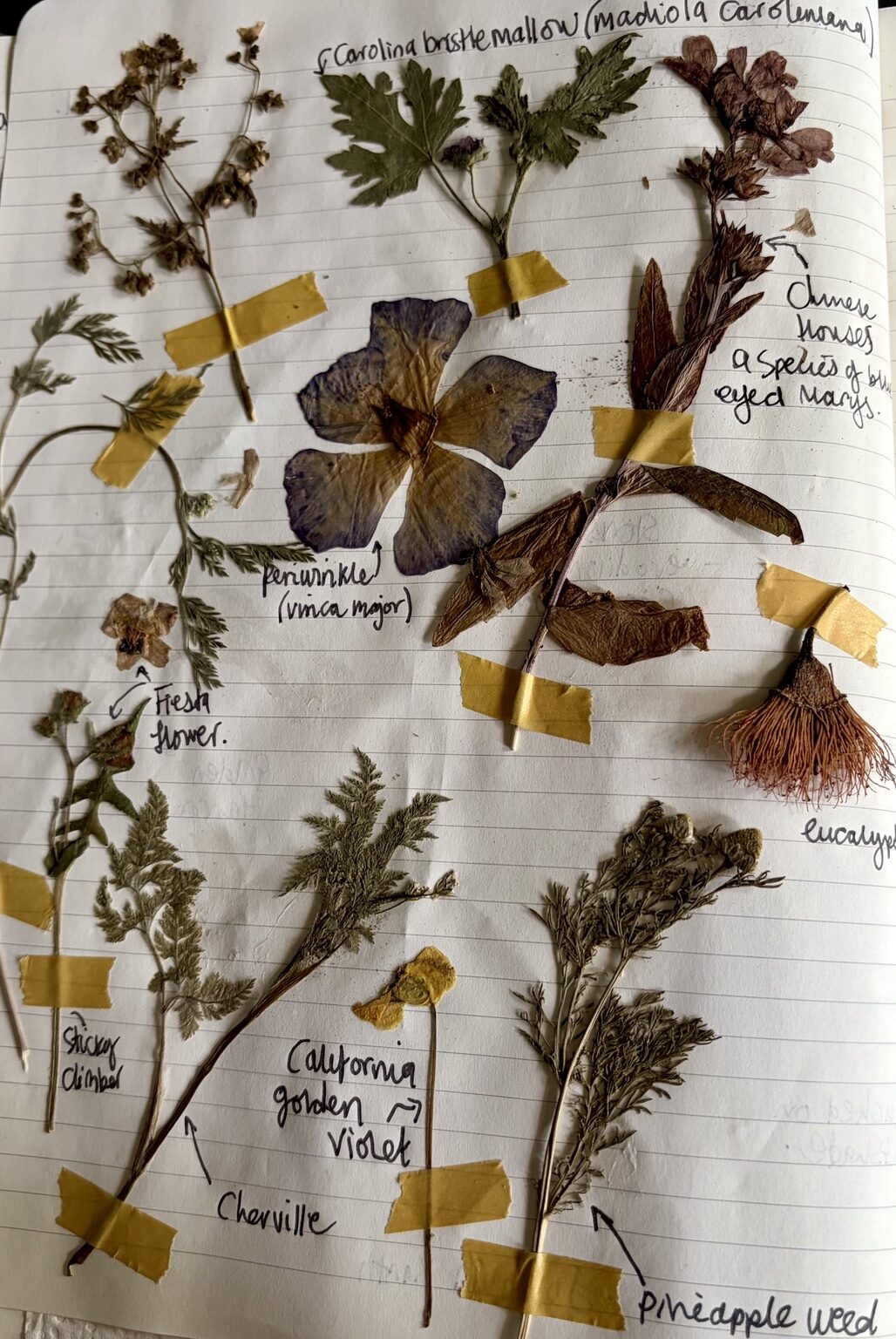
The past three days have been beautifully sunny—clear blue skies and picture-perfect spring weather. Lots of flowers are coming into bloom after the plentiful rains and now warming sunshine: nasturtiums, California poppies, wisteria just starting to pop open, dove’s-foot cranesbill, California golden violets and tiny white puffball flowers on long stems.
A pair of house finches certainly seem to be building their nest under the eaves of the front porch above me. Someone is singing a lovely little song—just caught sight of it! The male house finch, red-breasted and proud upon his podium: the electric wire. A solitary duck flies overhead.
March 28 · Ventura River PreserveApril 5 · Soule Park trails
This morning, a towhee—brown—was sat on the brick outside my window eating the seed I left out. I watched the nuthatches hop to and from the feeder, gathering peanuts and stuffing them into the bark of the tall pine tree.
Grosbeaks at the feeder—new visitors! A swarm of bees on the neighbour’s oak tree—moving to a new hive? They didn’t settle, must have been on the move. The beautiful wisteria blossom is starting to brown.
The towhee is the first to wake: “Chit-chit-chit-chit.”
Warm and sunny.
Climbed to Nordhoff Peak. Found many plants in bloom. Started the ascent in thick morning fog, but once we climbed higher, we penetrated it and came out into bright sunshine.
Ceanothus—California lilac.
Plants gathered around the time of the Nordhoff Peak walk.
Thick fog. The towhee is the first to rise. She sits right outside the window, pecking at fallen seed. The nuthatch climbs up and down the pine, to the oak, the feeder and back again.
How misty this morning. There seems suddenly to be an abundance of squirrels in the garden—babies, I think. They’re much smaller. I guess Momma just let them all come down to explore. Funny little things.
I’m worried about the bird nests. The neighbour has a tree trimmer pulling down branches from the oaks. Chainsaws buzzing. There are so many nests at the moment. Hopefully the pair of nuthatches have theirs in the pine, far away from that mayhem.
The feeders are exceptionally quiet this morning—after yesterday’s tree trimming? A lone squirrel, chiz-chiz-chizzling, little hands holding tightly to a savoured seed. At least it’s appreciated. He’s no more than a foot from my face right now and although he looks right at me, he doesn’t seem to see me. Foggy again.
A dark start to the day. Already the springtime buzz is slowing. Many of the early flowers have popped and died back. Pouring rain later.
Yesterday Ezra and I found a small dead bird at the end of the driveway. A towhee? Longish tail, about the size of my hand. A young one? Baby looked like a fledgling. No obvious sign of injury, though some blood from its beak. Poor fragile creature. We gave it a burial. Sounds like they’re strimming the grass again—lots of attempts!
A rainstorm passed through last night, but everything is glistening in sunshine this morning. Acorn woodpecker.
Clouds rolling back in.
Here comes Momma Squirrel—nabs a crust of bread and scampers up the tree with it. Stashed it somewhere, over in the pine I think; now she’s back for more. I haven’t spotted her drey yet. Not sure if it’s in our garden. No big nipples, but some little nips.
The full moon reigned, pink and resplendent. A hummingbird flies over and steals a stretch of cobweb from under the eaves.
There was a scuffle outside last night. Raccoons? Kirra’s been patrolling this morning, following scent trails.
Spotted an oriole! Yellow-orange capped head and blackish wings. I’m afraid Momma Squirrel was found dead on the road. Run over. People drive too fast. I hope she wasn’t nursing a new litter, but it looked like she may have been.
I’ve left seed and rice cake outside the window, but no squirrels have visited. Will the young ones visit on their own, or did they always follow her here? Sun is yet to shine through—still heavy-set fog. There’s a young squirrel across the neighbour’s fence.
May grey. Thick fog rolls in from the coast just before sunset and stays set in until afternoon.
In England. And perfect timing for two of my favourite blossoms—hawthorn and cow parsley.
Jacarandas—once vibrant with purple-blue flowers, now dropping their dried discs. I have three seedlings growing at home.
Little birds flying up to the eaves of the guesthouse with oversized insects in their beaks, negotiating the narrow gap between the roof and gutter. Turning themselves this way and that, dragging their haul of material inside eagerly. Industrious. A delicate, tiny, wren-like bird. Orangish hue. Twitching and cavorting.
How delightful to have a little wren singing its heart out here in front of my window, on the first sunny morning since our arrival back from England. The garden is alive with activity. We must have just about every bird visiting now as possible, plus squirrels and ground squirrels running to and fro. Litters very busy.
A poor, tiny house finch just flew into the patio doors. Completely knocked herself out, head down. I moved a plant pot from the window as she lifted her head. Need something to put here—lots of collisions. 57° and rain, rain, rain. Lots of gophers in the garden. Kirra has caught a couple.
Watching the little house finches stuff their beaks. Still no sunshine. There is daylight, grey and still, but no warming rays of sun.
We have a pair of house finches nesting under the eaves at the front—north side—of the house. Looks to be made of nice, soft moss. Is it a Bewick’s wren that nests under the guesthouse eaves, or house wren? Look for white eyebrows.
Yesterday a pair of hawks were stalking the garden. Didn’t get a good eye on them, just glimpses and heard their calls—assuming red-tailed.
I found the dusty remnants of a tiny songbird wing on the deck. Grey. Thankfully this morning I see that the pair of nesting wrens are still intact.
The clary sage is in full bloom. Shining purple flowers, lipped like its cousins mint and rosemary—fellow lamiaceans.
A trip out to Catalina. Observed some strange-looking herons nesting in a tall tree next to the mini golf course. There was a dead nestling on the ground.
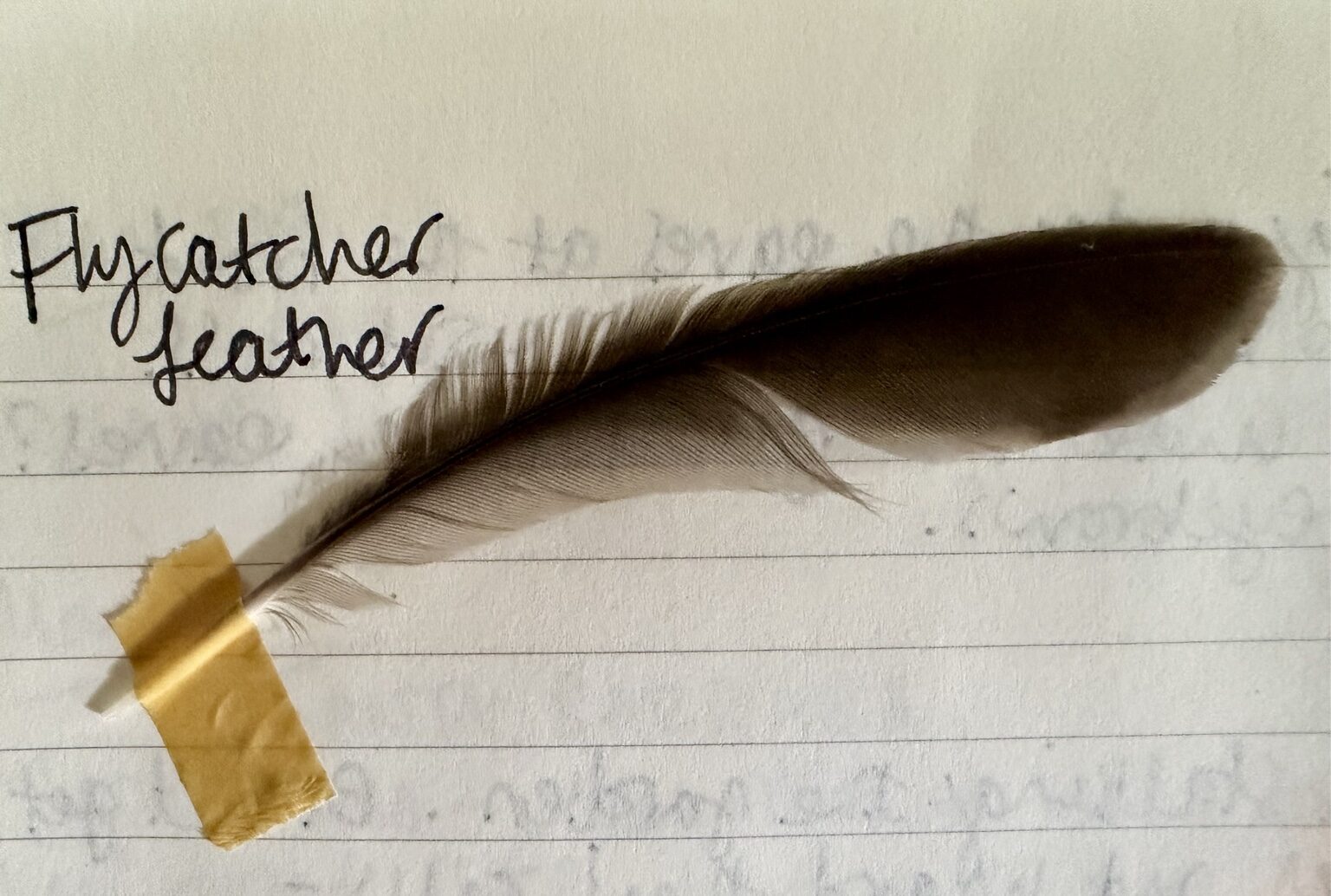
A little flycatcher is building a nest on the back—south-facing—porch.
The flycatcher still sits on her nest, occasionally fluttering down to feed, sitting on the fence momentarily before returning to her duties.
The wrens are still active under the eaves—the female seems to be incubating while the male busily flies back and forth. And a woodpecker! A rare visitor to this garden. Dead dolphin on the beach—lots of marine deaths due to algae tide.
The daylilies have opened again.
The wren family has grown—eggs hatched. I hear the little chicks in there, “chit-chit-chitting” away as their parents hurriedly flutter back and forth with brown grubs.
The flycatcher still sits on her nest, occasionally leaving to eat. Luckily the weather is warm now.
The little wrens are getting louder! And no doubt bigger. I wonder how many there are. The flycatcher seemed to be looking at her nest funny last night—eggs hatching?
The funniest little faces peeping out from under the eaves. Getting bigger, bolder and louder every day. Four little faces, trading food for poop bags—the adults carry the excrement away. Wrens fledge in 12–15 days.
Meanwhile the flycatcher fledglings are silent, still and patient. I spotted a couple of little faces last night, Momma sitting with them. I believe the wrens to be Bewick’s wrens, as the adults have pale eyebrows.
Flycatcher feather
The wrens have fledged—reportedly it happened last Friday while we were out of town.
The flycatcher chicks were sticking their heads out of the nest in the afternoon—I counted three. They looked hot in the 102° heat under the eaves. Panting. Next thing I know, they had fledged—an act of desperation to cool down? Encouraged by a parent, I don’t know. One sat down by the paddling pool, wings spread out wide to the sides to cool itself. I kept watch over it from a distance and got some photographs. The mother and father were returning to feed it, and after an hour or so, and the temperature dropping, it perked up and fluttered off into the oak tree to be with the rest of the family. Hopefully they all survive their first night out in the big world.
Green cabbage-butterfly caterpillars have devoured and destroyed my nasturtiums. Cabbage whites, leaving not a single leaf untouched. A tiny praying mantis has taken up residence on the vitis outside Mum’s cabin.
Rain! Unheard of in August in Southern California. Thunder. Owl excrement splattered over the pathway under a large branch of the oak tree. Great horned, I’m guessing. I occasionally hear them hooting back and forth to each other in the night.
A hurricane named Hilary is making its way up the Pacific coastline towards San Diego—potentially a category four at landfall.
No storm here yet. Just cloudy entrails. The prelude. A flock of small tit-like birds flew in when I watered the garden—I sprayed the trees and they drank the water off the leaves and washed their feathers. Bushtits!
Earthquake! 5.1. Shook us pretty good. Had a lot of rain yesterday and last night. “Earthquake weather,” apparently. Everything has had a much-needed soaking. The orioles are at the feeder, squabbling—always a lot of noise when they visit.
Lots of aftershocks. Just had a 3.9.
Exceptionally hot again, over 100°. Last night we walked up Shelf Road in the moonlight. The moon was reflecting over Ojai Valley. Not full yet, but already bright and splendid.
The belladonna lilies have bloomed again. Several little clumps around the lemon tree.
The morning mist and dew have become the norm again. We have a small colony of amusing ground squirrels living under the rocks by the bird feeder.
A grasshopper has made itself at home in the basil plant—growing rapidly. It just shed its skin. Not ravaging the plant too badly, just nibbles. Also a cocooned caterpillar on the tablecloth.
Warm balmy sunshine. The orioles have all left now, but the feeders are still busy with house sparrows, titmice and juncos. The finches seem to have moved on too; haven’t seen them in a while.
The squirrel population seems to have boomed. Hummingbird battle at the feeder: three Anna’s hummers—bomb diving. One standing guardian where five or six in total buzzed about. I did a display of dominance—flew up like an elevator, up and down in front of the feeder, stopped, took a sip and back to the wire to charge the next offender.
Spotted a grebe—western or Clark’s? Great blue heron, great egret and coot.
Turned the heat on! 42°.
Mr—or Mrs?—Grasshopper, who lives on our basil, is looking quite grand now. After going through another shedding he is now brown in colour and as long as my middle finger. Hot days in the nineties and cold nights in the forties.
Stood in the garage at twilight and two little rats emerged from above the cupboards. Their tiny heads over the ledge, watching, listening, little ears rotating like radars. One was more pensive as the other groomed and fussed over his mother’s head.
Rats! Squirrels! Ground squirrels! Gophers! Too many rodents under the feeders! Going to have to move them. Grasshopper still hanging out in his new brown attire. A younger green one has joined him.
Grasshopper is gone.
Unexpected rain in the night!
Full moon. 50°. Sunshine.
Jupiter sits just below the moon.
We’ve been away for a month. Still spotting gophers on the bank by the back deck. Haven’t seen any ground squirrels in a long time. Saw a couple of rabbits out back before we left. The owls have returned at night—lots of hooting.
A new pair of visitors to the bird feeder. Now that we are into the winter months, and the daylight has grown shorter, I have moved the bird feeders over to the front—west-facing—side of the house. I believe the new pair to be red-breasted nuthatches—certainly very similar characteristics and behaviours to the white-breasted cousin who should appear, perhaps blown out of the oaks in the wings of the afternoon.
A large praying mantis is hanging out inconspicuously on the railing of the back door. I scooped him up and moved him onto the clary sage. He is a survivor of the egg case I put out when we first moved in?
August 2024 — February 2026
Florida
Garden, woodland and water-edge observations: birds arriving and
leaving, plants flowering out of season, freezes, hurricanes and the
ordinary abundance of a Florida year.
2024
6:37 a.m. Cicadas whirring. Cuban tree frogs sounding like
squeaky shoes—two or three of them living in the fish house.
Finding dead cicadas: nymphs, shells and spent adults.
Hurricane Debby skirted through earlier this week. Lots of
rain and some wind gusts, but mild.
Flowering: gardenia, verbena, plenty of zinnias, hibiscus and
roses. Found two small snake skins, possibly baby rat
snakes—patterned backs. The cactus bloomed at night.
A notable contrast that proves pleasing to the eye:
beautyberries and the yellow flowers of pigeon peas. Both
wildlife-friendly.
The weather actually feels cooler in the mornings, with a
cooler breeze. I believe the chimney swifts have left now; I
haven't heard them chattering in a while. Then I heard catbird
calls the other day. More birdsong that I don't recognise.
Last week held a beautiful “super” harvest moon in Pisces.
Raining. Hurricane Helene skirted past to the northwest last
week. Next week we face a potential direct hit from Hurricane
Milton.
Still dark at 6:50 a.m., a faint blue light just starting to
fill the sky.
Noticing lots of bird arrivals: a pair of flycatchers, the
catbirds back, flocks of robins and small yellow visitors on
the feeders. Venus has been bright and large. Clear skies have
led to some great stargazing. The lacewings seem more active,
as do the gallinules.
Mugwort—Artemisia vulgaris—popping up along the fence
down at the ranch. Cold nights around 40°.
The skies are full of birds in the morning: swallows, robins
and ibis. At Lake Woodruff, a duck pair—blue-winged teal?
Robins swarm the camphor trees. Are they eating the black
berries? Lots of chatter. Saw a yellow-bellied or
yellow-throated warbler on the bird bath last night.
Camellias in full bloom. Many tree swallows fill the sky.
2025
Haven't seen the tree swallows in a while. Last night a flock
of whistling ducks circled over Deland. Ice on the banana
leaves yesterday and the bird bath was solid. Haven't seen the
large flocks of robins either—moved on?
Saw the tree swallows fly overhead yesterday, heading towards
the preserve.
A small yellow bird visited the feeder and ate the suet. A
warbler? Camellias are starting to brown. Toadflax growing in
the grass around the tent.
Tree swallows soaring above the house. Three otters at the
preserve. The weather has warmed after last week's freeze—70s
now.
Prune roses and citrus.
Rose growth and blooms. Azaleas popping. Eastern redbud—Cercis canadensis—in full pink bloom. Robins still present in large flocks.
The wrens sing loudly. Fritillaries coming out. Carolina
jasmine in full bloom.
Temperatures dropped close to a freeze. Covered all the
delicate leaves: papaya new growth, bananas and squash.
The fruit trees—apple?—are starting to bud, ready to bloom
into blossom.
Full azalea display. Spiderwort's purple flowers. Apple
blossom, orange blossom, lavender—everything in bloom.
Yesterday at Lake Woodruff: two bald eagles and lots of baby
gator pods.
Swallow-tailed kites! Three or four flying over the house.
Osprey nesting. Wrens gathering nesting material. Swarms of
caterpillars on the persimmon. Lyre-leaf sage flowering.
Hummingbirds.
Summer tanagers—an arrow formation of birds flying north.
Lubbers have hatched.
A pair of painted buntings visit the feeder. They have been
here since early March. No sign of the chimney swifts—did they
come when the chimney was still blocked? If so, I hope they
come back.
Cicadas have started singing. Frogs croaking; southern toads
at night. The bird-feeder area is abuzz in the evenings:
catbirds, northern cardinals, painted bunting pair, titmouse,
ruby-throated hummingbirds, red-bellied woodpecker and
Carolina wrens. The warblers seem to have moved on.
Giant eastern rat snake in the barn, looking for rats? It must
be six feet or longer. One of Ezra's lubbers shed its first
skin.
Red lilies in the blue barrels are just finishing their bloom.
Hawthorn coming to the end of bloom—small green haws. Oranges
have started forming. Tussock moth caterpillars are about.
Jacaranda has lost nearly all its leaves.
A cooler snap of weather after some rain in the night. A
catbird fledgling flew into the window; it sat in a tree a
little stunned. Chimney swifts flying over the house. Carolina
petunias blooming.
Last night I saw the swifts flying back into the chimney—maybe
four of them.
Yesterday I found a poor flycatcher fledgling, squished in the
road. Its parent stood over it.
Jacaranda blooming. Magnolias blooming. Southern toads
singing. Cicadas are back at the feeder by the dozen.
Great crested flycatchers heard, but yet to see. Painted
buntings have been more present this spring—could they stick
around to breed? We are right on the edge of their breeding
territory. Monarch caterpillars on the milkweed. Heard a
bobwhite in the woods here at home. Merlin heard a scarlet
tanager and goldfinch.
A fledgling. Beautyberry blossoming. Fruit starting on
persimmons. Magnolia warbler at the bird bath. Baby toads
around the koi pond. Privet blossom. Giant mimosa behind Mum's
blooming white flowers. Sandhill crane chicks about.
Glorybower blooming. Jacaranda. Silk tree. The weather is hot
and dry. A gopher tortoise passing through our yard.
Finally some rain. Saw a pigeon fledgling near Berryville
downtown. Snapping turtle at the preserve. Baby raccoons
everywhere.
Marshmallow blooms. In late September, the golden raintrees
yellow with blossom.
Rain, sun, rain, sun. Raintrees still full of blossom; some
have dropped most flowers and are now adorned in pink pods.
Marshmallow. Alba bidens going to seed. Spanish needle
seeding. A full bushel of bananas on our big plant. Lots of
ibis on the lawns.
Catbirds are back.
Catbirds have returned.
Heard a flock of birds in the garden, high in the canopy.
Couldn't make out what they were—possibly robins or warblers?
44° on the thermometer—I'm sitting here in a beanie. Brrr.
Phoebe. Cassia blooming. Buds on the Mexican sunflowers.
Golden raintrees dropping pods. One or two camellias.
Beautyberries heavy with fruit. Oranges starting to ripen.
Loquat blossoming. Merlin heard a yellow-billed cuckoo.
Red berries—cherry laurel? A freeze on the 11th and 12th.
Hundreds of tree swallows at the preserve. Otter. Swamp
sparrows. Warblers. Two eagles soaring over the chicken pen on
Veterans Day.
Giant katydid in the garden. White snakeroot—Ageratina jucunda—a poisonous, late-blooming pollinator flower. Ghost pipes in
the chicken run. Vultures. Mexican sunflowers visited by
monarchs, honey bees, a very fat and hairy bumblebee and a
ladybug. Marigolds—Zinnia elegans.
2026
Early January: tree sparrows everywhere in the evening.
Lyre-leaf sage is growing shoots ready to flower. Spiderwort
leaves growing.
January 16: 28°—frost. Catbirds calling in the evening. The
wren has started singing. Few birds, only a cardinal male at
the feeder.
January 24: Carolina jasmine flowering; redbud.
20° frost. Fields of ice over the blueberries and ferns.
Freeze damage: philodendrons dropped and brown; canna,
avocados, bananas, gingers and beautyberry; shrivelled loquat
fruits; Turk's cap, Alba bidens, papayas and orchid.
A small flock of cedar waxwings sit in the water oak behind
the house. A few days earlier there was a painted bunting on
the feeder. The Carolina wren has started its morning song in
full swing. Vultures lurk in the garden. Azaleas are now in
bloom. Some jasmine.