Five plants worth knowing

Plant Profiles

A closer look at five companions from garden, wayside and kitchen—met slowly through identification, story, scent, touch and use.

Botanical watercolor of a flowering herb sprig

← Return to the Herbarium

01

Plantain

Plantago major

One of the most easily overlooked useful plants, plantain often grows exactly where nobody thinks to look for it — in lawns, paths and disturbed ground. It forms a low basal rosette, with strong parallel ribs running through its leaves and slender, leafless flower spikes rising from the centre. Depending on the species, the leaves may be broad and rounded or long and lance-shaped.

Native to Eurasia and now naturalized widely across North America, plantain became so closely associated with European settlement that it acquired the evocative name “white man’s footprint” — said to spring up wherever settlers had passed.

Traditionally, the fresh leaves were crushed or chewed and applied as a simple poultice to minor bites, stings and irritated, unbroken skin. The leaves can also be infused into oil and made into salves, while young leaves are edible when correctly identified.

It is an ordinary-looking little plant with a remarkably long relationship with people — and a good reminder that a “weed” is often simply a plant whose story we have forgotten.

Broadleaf plantain growing among grass
02

American beautyberry

Callicarpa americana

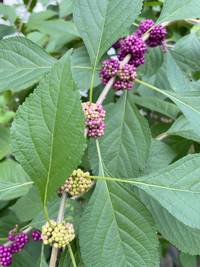
In late summer and autumn, American beautyberry becomes almost impossible to overlook. Brilliant violet-purple berries gather in tight rings around its arching stems, appearing precisely where the leaves meet the branches. Earlier in the year, its small flowers are much quieter, but valuable to visiting pollinators.

Unlike several of the other plants in this herbarium, beautyberry belongs here. Callicarpa americana is native to the southeastern United States, including Florida, and its berries provide an important seasonal food source for birds and other wildlife.

Beautyberry also has a fascinating place in Southern folk tradition. Its aromatic leaves were historically rubbed onto skin, clothing and animals as an insect deterrent — an old practice that gives this familiar woodland shrub another dimension entirely.

The berries themselves are sometimes gathered and cooked into jelly, although their greatest value in the landscape may simply be leaving them where they are: an extraordinary native plant feeding the lives around it.

American beautyberry with ripening purple berries
03

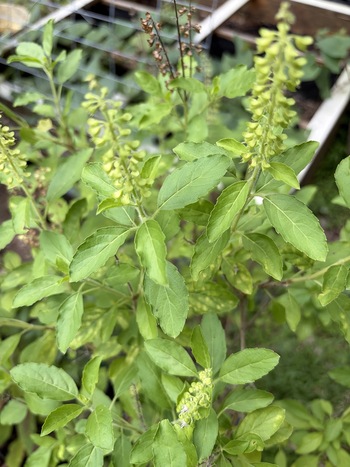
Tulsi

Ocimum tenuiflorum

Tulsi is an aromatic member of the mint family, recognizable by its opposite leaves, square stems and upright flowering spikes. Depending upon the variety, its stems and foliage may be green or flushed with purple, and crushing a leaf releases a warm, distinctive fragrance often described as clove-like.

Native across tropical and subtropical Asia into the western Pacific, tulsi is especially closely associated with India, where it has been cultivated for centuries. In Hindu tradition it is a sacred plant, traditionally grown around homes and temples and treated as considerably more than an ordinary culinary herb.

Tulsi also holds an important place in Ayurveda and has more recently become widely known in Western herbalism as an “adaptogenic” herb. One of the simplest ways to know the plant, however, is simply as tea: fresh or dried leaves steeped in hot water for around five to ten minutes produce a wonderfully aromatic infusion.

It is a lovely example of a plant in which medicine, daily life and spiritual tradition have never been entirely separate.

Tulsi plant with green leaves and flowering spikes
04

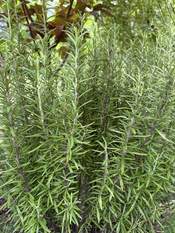
Rosemary

Salvia rosmarinus

A woody evergreen of the Mediterranean, rosemary is a plant of sun, stone and dry ground. Its narrow, aromatic leaves hold their fragrance year-round, while its small flowers — most often blue or violet — are eagerly visited by bees. Its old association with the Mediterranean is even preserved in its name, traditionally interpreted as “dew of the sea.”

Far more than a kitchen herb, rosemary has travelled alongside people for centuries. It has been used to flavour breads, beans, vegetables and roasted foods, but also infused into baths and hair rinses and incorporated into household and traditional herbal preparations.

Perhaps its most enduring story is its association with remembrance. Rosemary became a symbol of memory and fidelity, carried at weddings and funerals and woven into rituals for remembering the dead — hence the famous line, “Rosemary, that’s for remembrance.”

Here in Florida it appreciates the same things its Mediterranean ancestry suggests: plenty of sunshine and excellent drainage. Our humidity can be harder on it than our heat, so good airflow and avoiding persistently wet soil make an enormous difference.

Rosemary plant with green needle-like leaves
05

Mugwort

Artemisia vulgaris

Mugwort has a rather wilder reputation than the other plants here. A tall, strongly aromatic perennial, it bears deeply divided leaves that are green above but strikingly silvery-white underneath — one of the easiest features to use when identifying it.

Native to Eurasia and North Africa and now widely naturalized elsewhere, mugwort has followed human beings for centuries. It spreads vigorously by underground rhizomes and can become invasive, so this is one herb whose enthusiasm is worth remembering before inviting it into the garden.

Its folklore is wonderfully rich. Mugwort became associated with travellers, protection, dreams and women’s herbal traditions, and appears repeatedly in old European herbal lore. It has been burned as incense, added to baths, tucked into dream pillows and used in bitter aromatic preparations.

For me, the dream-pillow tradition is one of the nicest ways to encounter its folklore: a small amount of dried mugwort enclosed in a little cloth sachet and placed near the bed. Whether or not it alters your dreams, there is something compelling about sleeping beside a plant that generations before us also associated with the mysterious territory of the night.

Underside of mugwort leaves showing the pale silvery-white woolly surface Upper surface of mugwort leaves showing the green leaf surface

For learning and identification only. Always confirm a plant’s identity and seek qualified guidance before medicinal use.